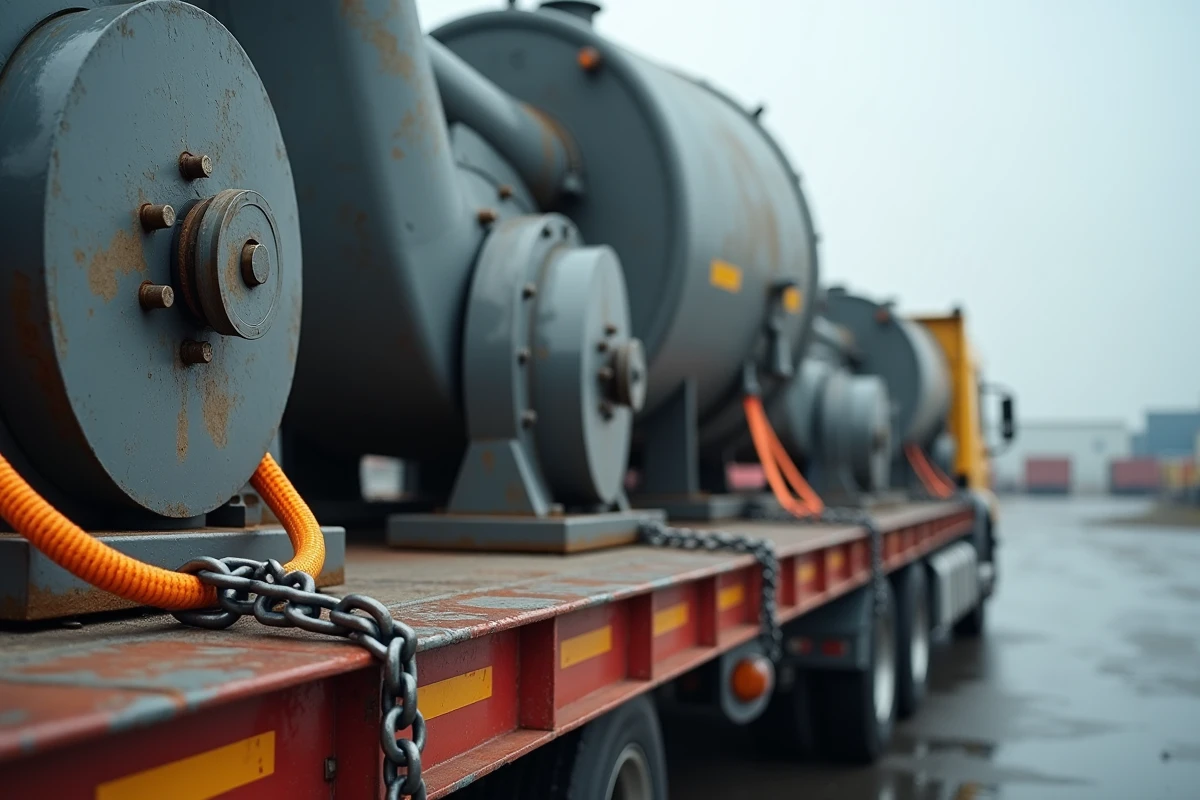
Transporting on a flatbed represents a specific segment of road freight, utilized whenever goods exceed the dimensions or weights compatible with a standard enclosed trailer. Industrial machines, metal framework components, construction equipment, precast concrete parts: these loads require an open vehicle, accessible from the top and sides, capable of accommodating non-standard shapes.
The French regulatory framework, reinforced by recent circulars from the Ministry of Ecological Transition, pushes carriers to refine their loading and securing practices well beyond the general payload rules.
Sensors and Telematics on Heavy Flatbeds
Most of the content available online describes the flatbed as a simple open trailer. What has changed in recent years is the arrival of IoT sensors directly on the flatbed structure. According to the 2023 report from the International Road Transport Union (IRU) on the digitalization of road transport, several major European carriers are now equipping their flatbeds with strain sensors on anchor rings and load shift detectors.
The goal goes beyond simple geolocation of the tractor. These devices measure in real-time the stresses exerted on the attachment points during braking, turning, and acceleration. When a tension threshold is exceeded, the driver receives an alert. On a flatbed transporting a tank weighing several tons, a slip of a few centimeters can alter the weight distribution and compromise the vehicle’s stability.
This instrumentation also serves as a commercial argument. In industrial tenders, the traceability of the load’s behavior in transit becomes a selection criterion. A client shipping an electrical transformer or a bridge module prefers a carrier capable of providing a timestamped history of the stresses endured during transport.
To better understand how road transport on flatbeds is adapting to current demands, one must look at these technological advancements rather than just the mechanical characteristics of the vehicle.

Flatbed Regulations and Road Checks: What Has Tightened
The DSR circulars published in 2023 and 2024 by the Ministry of Ecological Transition have intensified checks on exceptional transports and heavy loads. This tightening is not limited to oversized convoys: it also concerns standard flatbeds as soon as the load approaches the limits of the maximum authorized weight (PTAC).
In practical terms, carriers are adopting more cautious loading margins than a few years ago. The use of dimension and weight studies conducted by specialized firms is becoming common, even for operations that do not strictly fall under exceptional transport. A flatbed loaded with steel framework components, for example, may comply with total weight but pose an axle load distribution issue that only a prior calculation can verify.
Sanctions apply not only for exceeding the load but also for the quality of securing. A road check verifies the number of straps, their condition, the compliance of anchor points, and the presence of wedges or anti-slip pads. A detected securing defect leads to the immobilization of the vehicle, not just a simple warning.
Systematic Verification Points During a Check
- Compliance of the number of straps relative to the declared weight, with verification of the maximum load capacity (CMU) of each strap.
- Condition of the anchor rings on the flatbed: absence of deformation, visible corrosion, or mechanical play.
- Load distribution by axle, measured by onboard weighing or on a weighbridge, and compared to regulatory limits.
- Presence of additional devices (wedges, chocks, anti-slip mats) suitable for the nature of the transported goods.
Low Emission Zones and Access for Heavy Flatbeds in Cities
Between 2022 and 2024, several French metropolitan areas (Lyon, Marseille, Grenoble, Rouen) have expanded or tightened their Low Emission Zones (ZFE). For a heavy flatbed truck, often classified as Euro V or lower in the oldest fleets, this means access restrictions to city centers, or even a total ban during certain time slots.
The problem is that construction sites, industrial locations, and logistics depots are frequently located within these perimeters. A carrier delivering a prestressed concrete beam to a site in a ZFE must have a vehicle compliant with Euro VI standards or request a temporary exemption. Exemptions are still granted on a case-by-case basis, with processing times complicating delivery planning.
This constraint accelerates the renewal of heavy flatbed fleets towards newer engines. Field reports vary on the actual cost of this transition: some carriers absorb the extra cost into their rates, while others pass it directly onto the price per kilometer charged to the client.
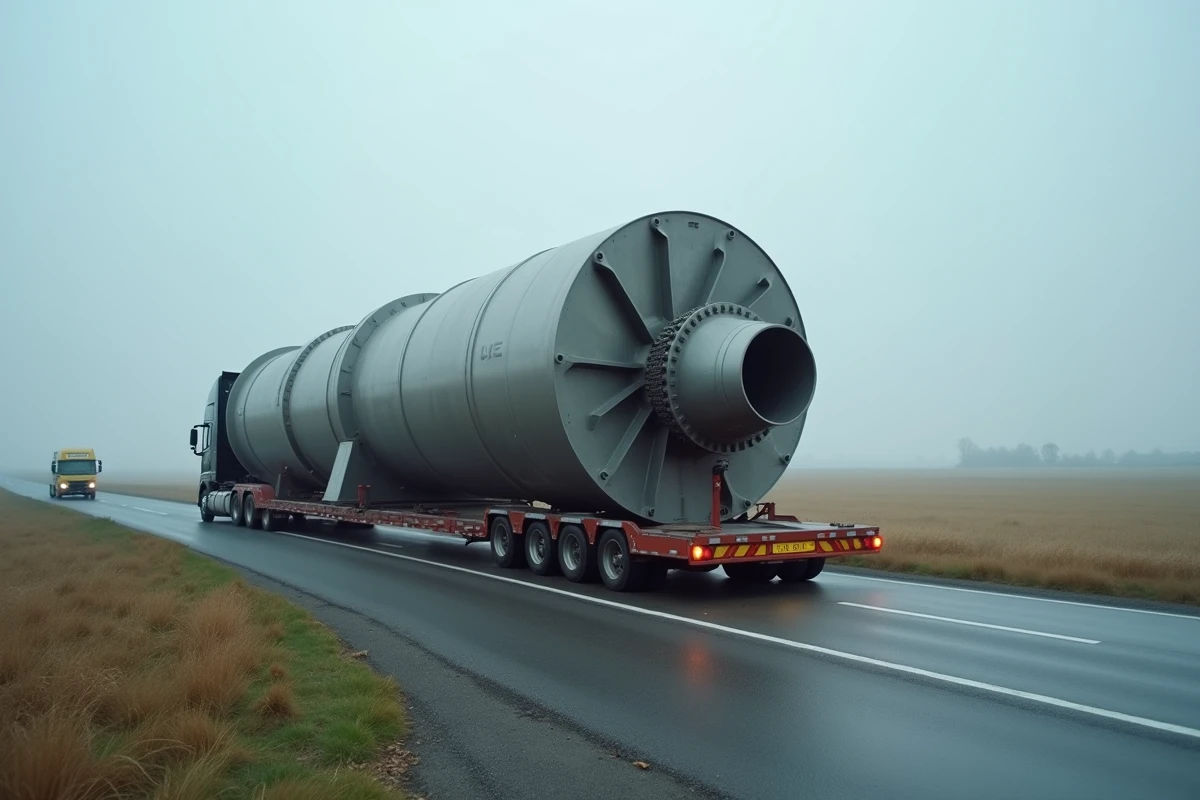
Securing Loads on Flatbeds: Common Mistakes
Securing loads on an open flatbed follows physical principles that routine can sometimes overlook. The first common mistake concerns the undersizing of straps. Each strap has a maximum load capacity, and the sum of the CMUs must at least cover the calculated sliding force for the transported weight, taking into account longitudinal and lateral accelerations.
The second mistake relates to the angle of strapping. A strap positioned at too wide an angle relative to the vertical loses a significant part of its holding capacity. Experienced operators aim for an angle between vertical and about 30 degrees relative to the load.
Blocking and Surface Protection
An anti-slip mat between the load and the flatbed increases the friction coefficient and reduces the number of straps needed. Without this mat, a metal load placed on a steel flatbed can slide under strong braking, even if properly strapped. Wooden or high-density plastic wedges complement the setup by blocking longitudinal movements.
Protecting the edges of the load, at the point of contact with the strap, prevents both damage to the goods and premature strap failure due to abrasion. Edge protectors made of polyethylene or metal are used at each contact point.
Transporting heavy goods on flatbeds is evolving under the combined pressure of regulation, onboard technology, and urban restrictions. The choice of carrier now relies as much on their tracking equipment as on their load capacity, a criterion that clients are increasingly incorporating early in their specifications.