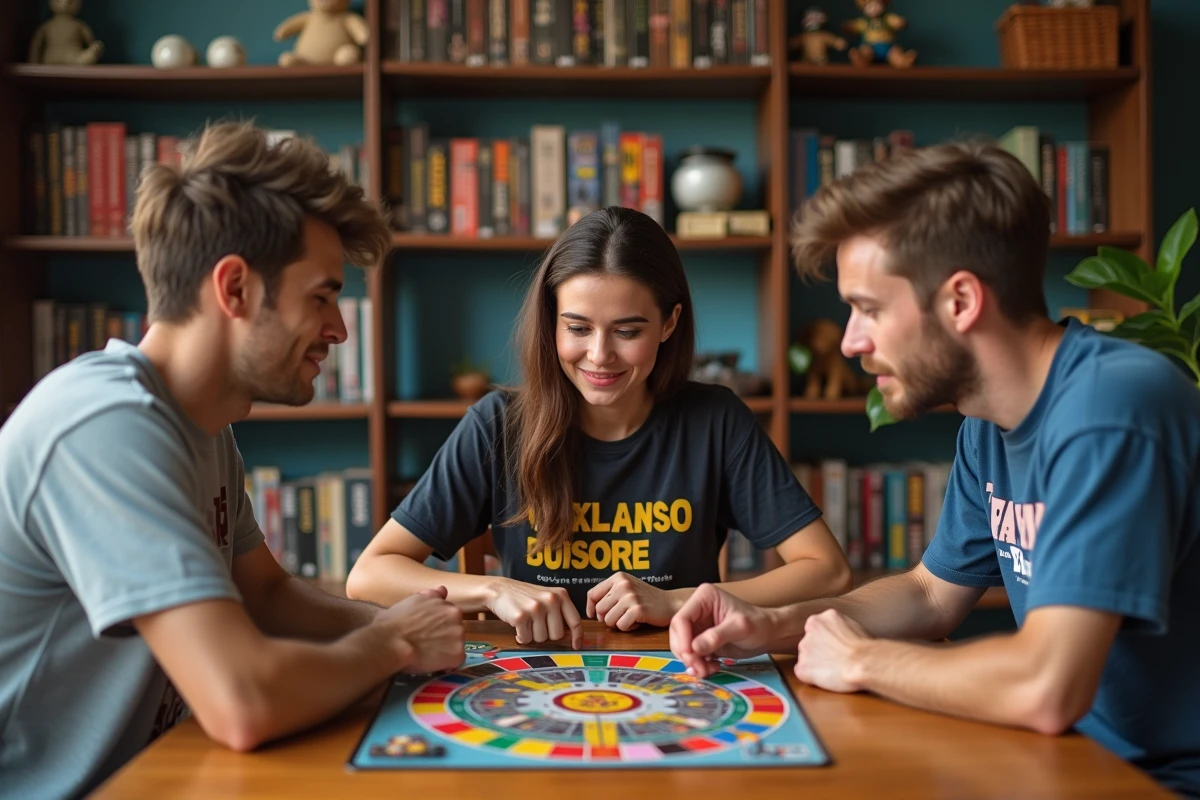
A board game inspired by a TV series typically has a stronger-than-average launch upon release but shows a shorter shelf life in specialty stores. In contrast, some original, non-licensed titles, buoyed by enthusiastic word-of-mouth, achieve remarkable longevity.
In 2023, the global board game market surpassed $17 billion, marking a 20% increase over five years. Publishers are increasingly collaborating with video game studios and pop culture franchises, creating new avenues for creativity and distribution.
Why Pop Culture Has Become Essential in Modern Board Games
It’s impossible to overlook: pop culture is present at every stage of game creation. Cult series, blockbusters, legendary comics, iconic video games… These familiar universes now overflow from the small or big screen to assert themselves on game boards and in the rules of play. This fusion is not trivial: it meets an immediate need for identification among players while benefiting from the accelerated circulation of references thanks to digital media.
When a license drawn from pop culture enters a game, the effect is immediate: a hero is recognized, an atmosphere is evoked, shared stories are literally replayed. The board becomes a direct extension of the collective imagination. The result: the game brings together, unites, and resonates with a whole table that already shares a foundation of references. This phenomenon is not limited to France. Everywhere, the industry is seizing pop culture to shape an offering that speaks to everyone, far beyond just the circle of the “initiated.”
From a business perspective, the formula works: publishers ride the evocative power of these universes and benefit from already established communities. The numbers show it: the audience demands shared experiences, cross-referenced references, games capable of bridging generations and styles. It is in this context that sites like stratetgeek.fr become allies, deciphering how pop culture redefines usage and stimulates innovation in the sector.
Video Games, Series, Comics: How Do These Universes Reinvent Our Game Nights?
Video games no longer just occupy our screens: they join the table, influencing the very mechanics of board games, shaking up traditional codes in the process. Adaptations, inspirations, reinterpretations: the boundary between virtual and physical games is becoming increasingly porous. Cooperative modes from the digital realm, narrative arcs inherited from series, all of this nourishes current creation. This is not just a nod to pop culture. We are talking about a fundamental wave.
Here’s how these influences manifest concretely in modern games:
- Cards adopt mechanics typical of RPGs and strategy games.
- Entire worlds from TV series or comics become the setting for collaborative adventures or unprecedented strategic contests.
- Players manipulate codes, lexicons, and moral dilemmas directly borrowed from the realm of video games.
This blending works because the audience demands it. Players want hybrid experiences, where the digital extends the game: scannable QR codes, companion apps, evolving scenarios updated online… Pop culture games provide fertile ground, encouraging diversity of practices and profiles around the table. Publishers, for their part, are multiplying partnerships to embed each new game in a shared collective imagination.
Ultimately, game nights no longer resemble those of yesterday. They blur the boundaries between generations, mix influences, and build new social rituals. Universes from video games, series, or comics now serve as the foundation upon which today’s playful moments are invented.

Overview of Trends and Games That Are Thriving Today Thanks to Geek Culture
Immersive technologies are changing the game in the world of board games. Creators are embracing augmented reality and virtual reality to design experiences where the physical and digital respond to each other. The result: renewed mechanics, more interactive games, and players enthusiastically adopting these new tools from geek culture.
Several major trends illustrate this evolution:
- Augmented virtual reality transforms the game table by projecting digital elements onto the real board.
- Artificial intelligence intervenes in scenarios, adapting the story and challenges based on players’ choices.
Publishers, for their part, are surrounding themselves with artists from pop culture to offer striking visuals, in-depth narrative universes, and richer scenarios than ever. We are witnessing a rise in games that incorporate mobile applications, true bridges between the physical object and the player’s digital ecosystem.
The impact of this movement is also reflected in how communities are organized: the search for connection, sharing, and collective experience now takes precedence. Games that unite, create dialogue, and integrate new technologies are establishing themselves as the new essentials. Game nights, reflecting the evolution of popular culture, testify to a sector that refuses to stagnate and relentlessly forges new paths.
Board games are no longer a discreet pastime lurking at the back of a cupboard. They are making a loud and inspired entrance into our daily lives, carried by the wave of pop culture. And this movement, resolutely, does not seem close to stopping.