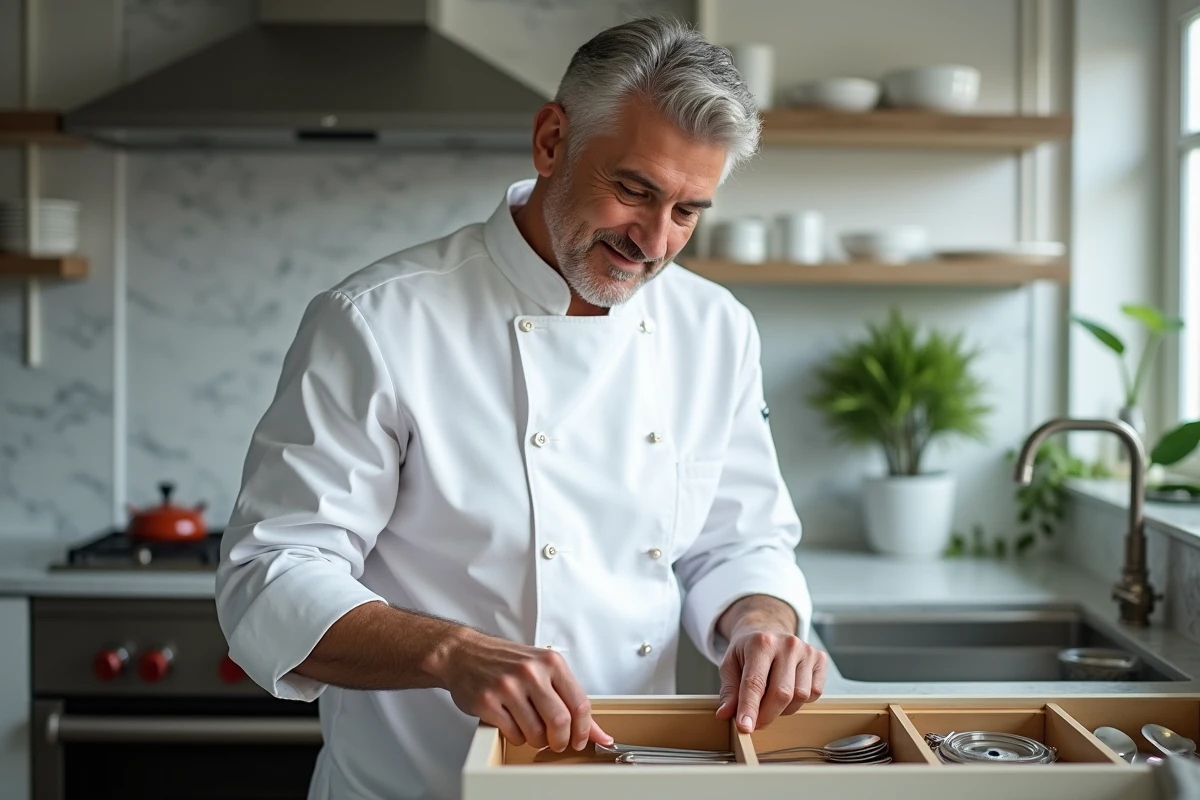
Professional kitchens prohibit the superfluous but sometimes tolerate functional deviations dictated by space or budget. The layout of the work surface takes precedence over the brand of appliances. Some chefs prefer a simple, well-sharpened paring knife rather than an entire block of expensive utensils.
Ergonomics cannot be improvised: a poor layout slows down service and increases fatigue. The choice of materials determines durability far more than trends or aesthetics. The equipment used in homes rarely differs from that of professionals, provided some fundamental rules are followed.
How can you recognize a chef’s kitchen at home?
A chef’s kitchen at home is not just a collection of the latest gadgets. What stands out first is the organization: each utensil awaits its mission, each space serves a precise action. The workspace stretches out, clean and clear, ready to accommodate cutting or plating without ever hindering movement. Here, no space is wasted; every centimeter is designed to simplify, streamline, and speed up daily tasks.
The layout reveals a concern for efficiency: everything flows logically, from the storage of ingredients to the hot plate. Sliding storage, hanging utensils, well-aligned spices: every detail recalls the operation of professional kitchens. Robust materials, sharp knives, and surfaces that can be cleaned with a single motion are prioritized. Even the lighting does not deceive: it highlights textures and colors without overwhelming the room.
To push the limits, think modularity: a rolling cart, a removable shelf, and the space adapts to every desire. Equipping your kitchen like a professional means getting to the essentials, focusing on the useful rather than the showy. Designing your kitchen like a chef means choosing effective simplicity, an order that unleashes creativity.
Essentials for a functional and inspiring layout
The worktop serves as the backbone: without it, nothing progresses. Wide, deep, and easy to clean, it accommodates preparation and plating. Stainless steel or composite materials are essential for their durability and quick maintenance; cleanliness is never a detail here.
The central island is not just a matter of style. It structures the room, multiplies preparation surfaces, and facilitates both circulation and interaction. Well-arranged furniture and storage under the worktop allow easy access to dishes, utensils, and supplies without ever overcrowding the space.
Here are the elements to prioritize for a truly practical kitchen:
- A generous sink, placed near the cooktop, to seamlessly transition from rinsing to peeling to cooking.
- A built-in oven at eye level, allowing you to monitor cooking while protecting your back.
- Specific outlets for appliances, to avoid the clutter of cables lying around the worktop.
The lighting deserves your full attention. A general source, complemented by directed lights over preparation areas, avoids misleading shadowy spots. For professionals, the layout is built on anticipation: adapting furniture, choosing sliding or modular storage, all aimed at making the kitchen more pleasant and efficient. Inspiration arises from the precision of the gesture, the simplicity of materials, and the intelligence of the arrangement.

Concrete examples and tips to avoid common mistakes
A kitchen layout inspired by professionals relies on a few easy-to-adopt reflexes. Too often, the worktop proves too narrow: prefer a depth of 65 to 70 cm. This way, you can place your appliances without compromising space for chopping, kneading, or plating.
Respecting the activity triangle—sink, cooking, refrigerator—saves time and conserves steps. The layout should facilitate every movement, never complicate it. Electrical outlets must be accessible but always out of reach of splashes.
Here are some simple tips to improve the functionality of your kitchen:
- Choose sliding storage: it makes pots at the back as accessible as those at the front.
- Set up a spice and condiment corner near the cooktop: saving time is also part of the professional spirit.
- Opt for LED lighting under high cabinets: this eliminates all shadows on the worktop, ensuring you don’t miss any details.
Chef’s kitchens are also organized to keep circulation fluid, like in a dining room. Access to the table must remain clear. Dare to use a mobile bar, a rolling cart, or small shelves for cookbooks, as long as the space breathes. What matters is adjusting every detail to your actual usage. Test, move, redo until you find the layout that reflects you. The perfect layout is one that inspires you to invent a new recipe every day.